The hundred feet that protect the house
Defensible Space & Fuel Reduction
Brush cleared, ladder fuels down, limbs up off the roofline, and the slash chipped before we leave. Fire-smart work by a licensed local crew.
Licensed & insured
CSLB #1132934
ISA certified arborists
Trained tree care, not tree butchery
Native owned, family run
Owned and run by a Humboldt family
5 stars on Google
100+ reviews from real neighbors
Every fire season, the North Coast gets a reminder that the trees we love are also fuel. Defensible space is the buffer you build around your home: the roughly one hundred feet where vegetation is spaced, pruned, and cleaned up so a wildfire loses its ladder before it reaches your walls. It is the single most effective thing a rural or edge-of-town homeowner can do for their property, and it is work we do year round across Humboldt and Del Norte.
How fire moves, and how we break the path
Fire climbs. It runs along dry grass and duff, steps up into brush, and uses low limbs as a ladder into the canopy. Once it is in the crowns, wind does the rest. Defensible space work attacks each rung of that ladder:
- ✓Surface fuels: dead brush, leaf litter buildup, downed limbs, and the woodpile leaning on the siding all get cleared or relocated.
- ✓Ladder fuels: we limb trees up so there is clean vertical separation between the surface and the canopy, and prune brush away from the trunks it would carry fire into.
- ✓Continuity: dense, touching brush gets thinned into islands with real spacing, so fire cannot walk plant to plant toward the house.
- ✓The structure itself: limbs over the roof come back, and anything dead within reach of the house comes down.
State guidance from CalFire describes this as zones: the first few feet around the structure kept clean and ember-resistant, the first thirty feet lean and green, and the area out to a hundred feet reduced and separated. We plan the work to that framework and to what your parcel actually looks like, because a foggy Trinidad lot and a dry Willow Creek hillside do not need the same treatment.
What a project looks like
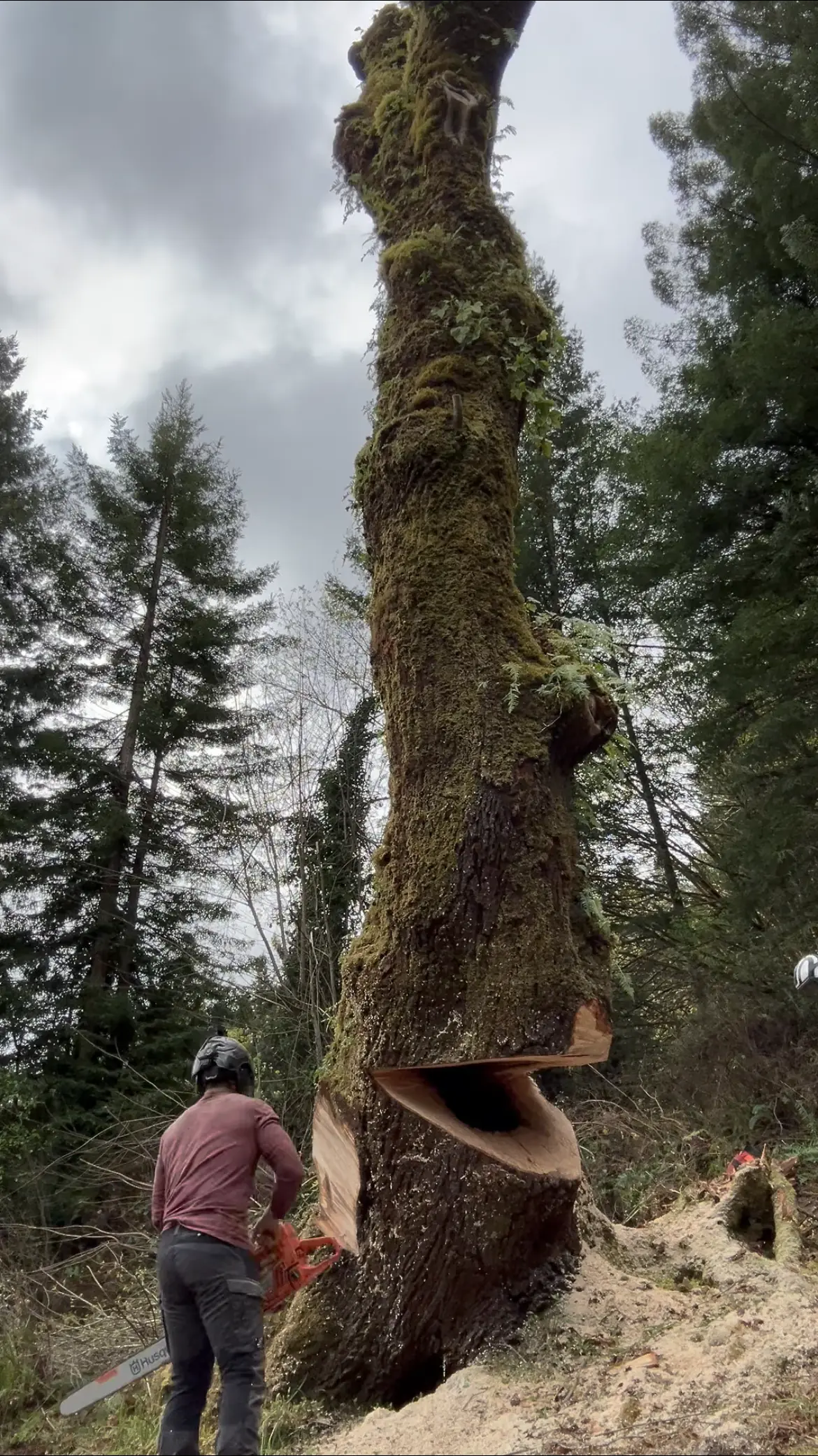
It starts with a free walk of the property. We flag what needs to come out, what should be pruned, and what can simply stay, and you get a firm written quote before anything runs. On work day the crew clears and limbs, and the chipper travels with us: slash is chipped on site the same day, never left in piles that become next year's fuel bed. Chips can stay for your paths and beds or leave with us. Larger clearing projects can be staged across seasons, and we will tell you honestly which parts matter most if the budget wants an order of operations.
The same crew and equipment handle the related jobs rural properties ask for: brush clearing and chipping, fence line and driveway clearing, andhazard tree removalwhere a dead or dying tree stands inside the buffer.
Why this is tree-company work
Anyone with a weed whacker can mow grass. The part of defensible space that changes outcomes is the tree work: which limbs to raise, which trees to thin, what a healthy tree can lose and what kills it. That is arborist judgment, and it is the difference between a property that is fire-smart and one that is just bald. Our ISA certified arborists make those calls tree by tree, and the crew doing the cutting is the same licensed, insured crew from every other page on this site. CSLB #1132934.
Where we do it
Defensible Space & Fuel Reduction by town
Every town has its own page, written for its trees, its lots, and its weather.
Defensible Space & Fuel Reduction in Humboldt County →
- ArcataThe classic Arcata hazard is a redwood or Sitka spruce planted in the 1970s that is now a …
- EurekaThe trees that worry Eureka most are the old Monterey cypress, eucalyptus, and pine plante…
- McKinleyvilleWind-formed shore pine and Sitka spruce with a permanent lean and dead limbs over a house …
- FortunaFortuna's storm failures are cottonwoods and willows along the river shedding big limbs, a…
- FerndaleThe dominant Ferndale hazard is an aging windbreak tree, a huge Monterey cypress or blue g…
- CuttenThe Cutten hazard is redwood limb weight over roofs and Douglas firs that have died back a…
- Rio DellStorm-worn Douglas fir and Monterey pine near houses, and cottonwoods that drop limbs ever…
- Willow CreekDrought-stressed firs and pines dying from bark beetles, and black oak limbs over roofs, a…
- Blue LakeFast-growing cottonwoods and alders along the river dropping limbs young, and hazard firs …
- TrinidadWind-formed Sitka spruce and cypress windbreaks that have outgrown their root systems and …
Defensible Space & Fuel Reduction in Del Norte County →
- Crescent CitySalt-damaged, wind-broken conifers near homes, and leaners that get a little worse every w…
- Smith RiverAn old, gappy, or overgrown cypress and spruce windbreak that has stopped protecting the h…
- Fort DickStorm-broken windbreak trees dropping on outbuildings and fence lines are the Fort Dick ca…
- GasquetDead and leaning firs and pines over cabins in steep terrain are the Gasquet removals that…
- HiouchiBig second-growth redwood and fir limbs over homes, and hazard trees in tight spots betwee…
- KlamathSitka spruce and redwood leaning over houses after a winter system stalls on the river mou…
Defensible space questions
What does defensible space clearing include?
Brush and ladder-fuel removal, limbing trees up and away from structures, thinning dense growth so fire cannot walk from plant to plant, and clearing dead material. We chip the slash on site and haul what you do not want. Every property is different, so the work starts with a walk of the whole hundred feet.
Do I have to clear everything within 100 feet?
No. Defensible space is about spacing and separation, not scorched earth. Healthy, well-spaced, well-pruned trees and plantings can stay. The goal is breaking the path fire travels: off the surface, up into limbs, and across continuous brush.
When is the best time to do this work?
Before fire season, which on the North Coast means late fall through spring. Cool, wet months are also easier on the land and keep us clear of nesting season for a lot of the heavy brush work. If summer is when you got the notice or the motivation, call anyway; the work can be staged safely.
Is defensible space work expensive?
It ranges more than any service we offer, because a tidy suburban lot and ten overgrown rural acres are different jobs. Assessments are free and the quote is firm. Financing is available for bigger projects, and staging the work over two seasons is a normal, sensible way to spread it out.
Ready for a straight answer about your trees?
Free quotes. Honest recommendations. A clean site when we leave.