Trimming Redwoods and Big Conifers in Arcata Without Wrecking Them
Arcata sits right against the redwoods. The Community Forest comes down to the edge of the neighborhoods, the hills behind Cal Poly Humboldt are solid conifer, and a lot of the older streets were laid out around trees that were already there. Add the redwoods and firs people planted in yards over the last sixty years, and you get a town where a fair number of houses have a tree next to them that is taller than the house is long.
Those trees are the reason people love living here. They are also the reason we get calls every week from Arcata homeowners asking some version of the same question: this thing is huge and it is close to my house, what do I do with it? This guide is the long answer. It covers what trimming can and cannot do for a big conifer, how we do it, the one thing you should never let anyone do to a redwood, and how to tell the difference between a tree that needs work and a tree that just needs to be left alone.
What trimming a big conifer actually accomplishes
Trimming a redwood or a fir is not like trimming a hedge. You are not shaping it, and you cannot make it smaller in any meaningful way without hurting it. What you can do is change how it interacts with everything around it, and reduce the parts of it most likely to fail. Here is what a proper trim on a big Arcata conifer is usually trying to accomplish.
Clearance
Limbs off the roof, off the gutters, out of the chimney's airspace, away from the siding, clear of the service lines. Clearance trimming is the most common conifer job in Arcata and the one with the most obvious payoff. A limb rubbing on a roof in every wind eventually goes through the roof. Branches loading the gutters with needles every fall are why the gutters overflow. Getting a few feet of daylight between the tree and the house solves a lot of small problems at once.
Deadwood
Every big conifer carries dead limbs, and in the wet North Coast climate the dead ones rot at the union and come down without warning. Deadwooding a tree means climbing it and removing the dead and dying limbs throughout the crown. On a redwood over a driveway or a deck, this is the difference between a tree you can enjoy and a tree you flinch under.
Crown thinning and weight reduction
Sometimes a limb is alive and healthy but simply too long and too heavy for where it is. A big lateral limb reaching out over a garage on a Sitka spruce or a Douglas fir can be shortened back to a good lateral branch, which takes weight off the union without leaving a stub. Thinning selective interior growth lets wind move through the crown instead of pushing on it. Done right, it is subtle. You should not be able to tell from the street that the tree was trimmed, only that it looks healthier.
Lifting the canopy
Removing the lowest limbs, the ones you have to duck under or that shade the whole yard, is called crown raising. On a redwood in a small yard this is often the single most useful cut. It opens the space underneath, lets light reach the lawn and garden, and keeps the limbs off the fence and the neighbor's side. It also makes the tree look like it belongs there instead of swallowing the lot.
The one thing you should never let anyone do: topping
Topping means cutting the main stem or stems of a tree back to stubs to make it shorter. On a redwood it is close to the worst thing you can do, and it is still offered around here by people who should know better.
Here is why. A redwood responds to topping by sending up a broom of new shoots from just below the cut. Those shoots grow fast, because the tree is trying to replace the crown it lost, and they are attached only to the outer layers of the old stem instead of being structurally part of the tree. Within a few years you have several new tops, each one poorly attached, each one heavier every season, all of them competing. The tree is now taller than it would have been if you had left it alone and far more likely to lose a top in a storm. Meanwhile the big cut at the top never really seals on a redwood and becomes an entry point for decay.
So a topped redwood is a tree that is ugly, less stable, and set on a path where it needs more work forever. If a company suggests topping your redwood to make it shorter or safer, get a second opinion. If the honest problem is that the tree is too tall for where it stands, the honest options are proper crown reduction where it is possible, or removal. Topping is not a middle path. It is a bad path.
How we trim a big redwood or fir in an Arcata yard
The job starts with the same arborist assessment we do for any tree: reading the tree for decay, weak unions, and dead tops, mapping what is underneath it, and agreeing with you on what the trim is supposed to achieve. Then the climber goes up.
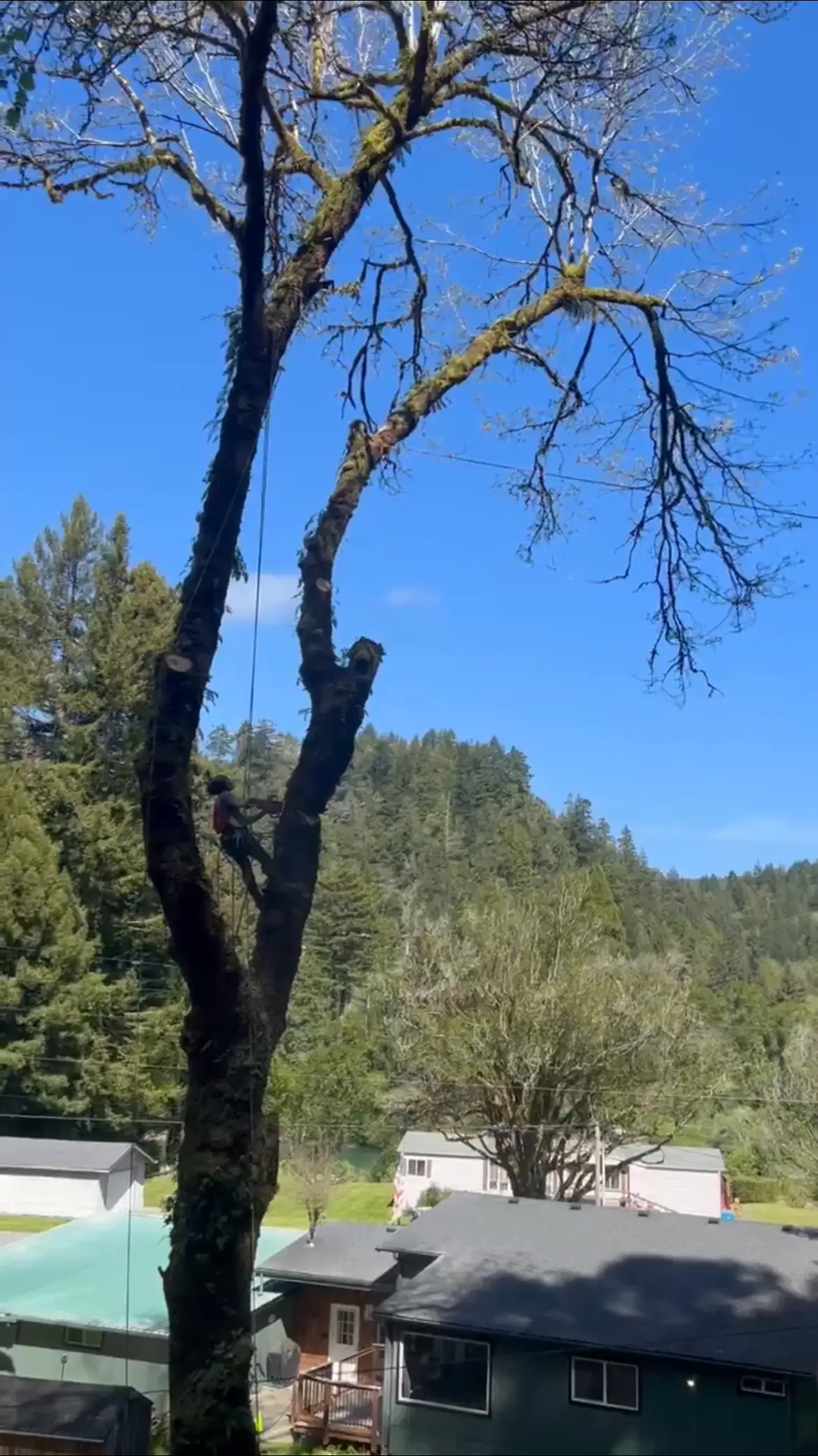
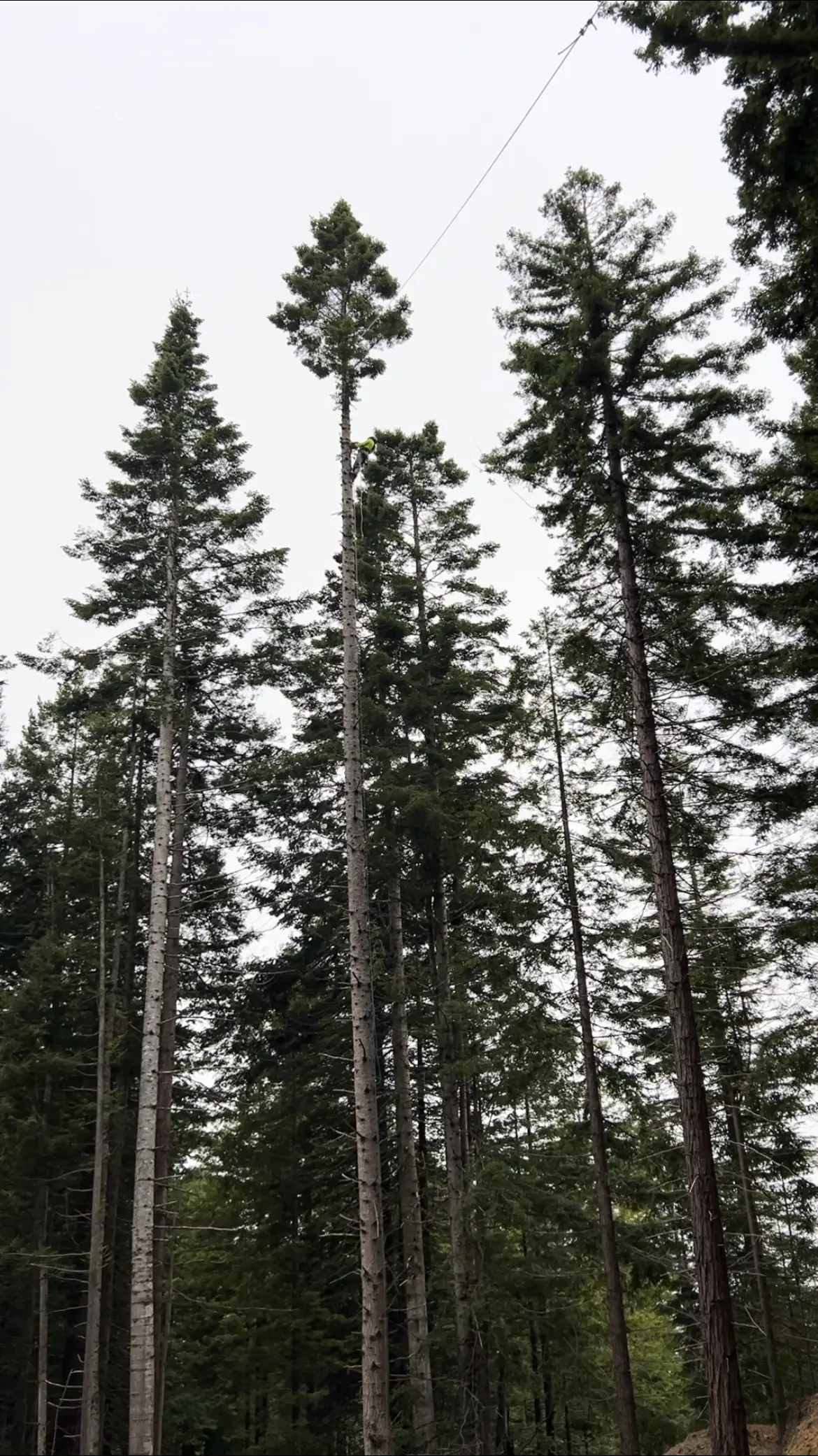
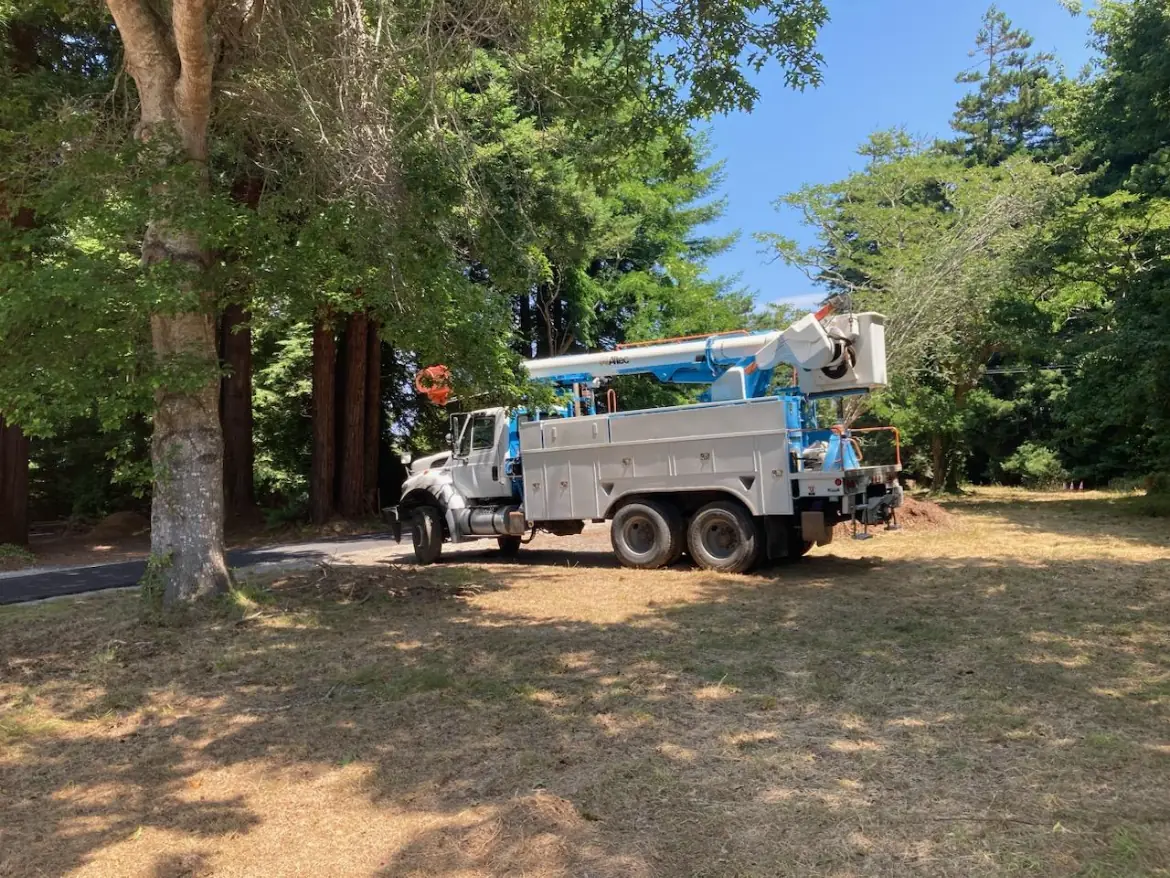
Big conifer trimming in Arcata is climbing work. Bucket trucks help on street trees and open frontages, but a redwood tucked behind a house with a fence on both sides is reached by a climber on a rope, moving through the crown limb by limb. The climber makes each cut at the right spot, which on a conifer means just outside the branch collar, the slightly swollen ring where the limb meets the trunk. Cutting there lets the tree seal the wound. Cutting flush against the trunk, or leaving a long stub, does not.
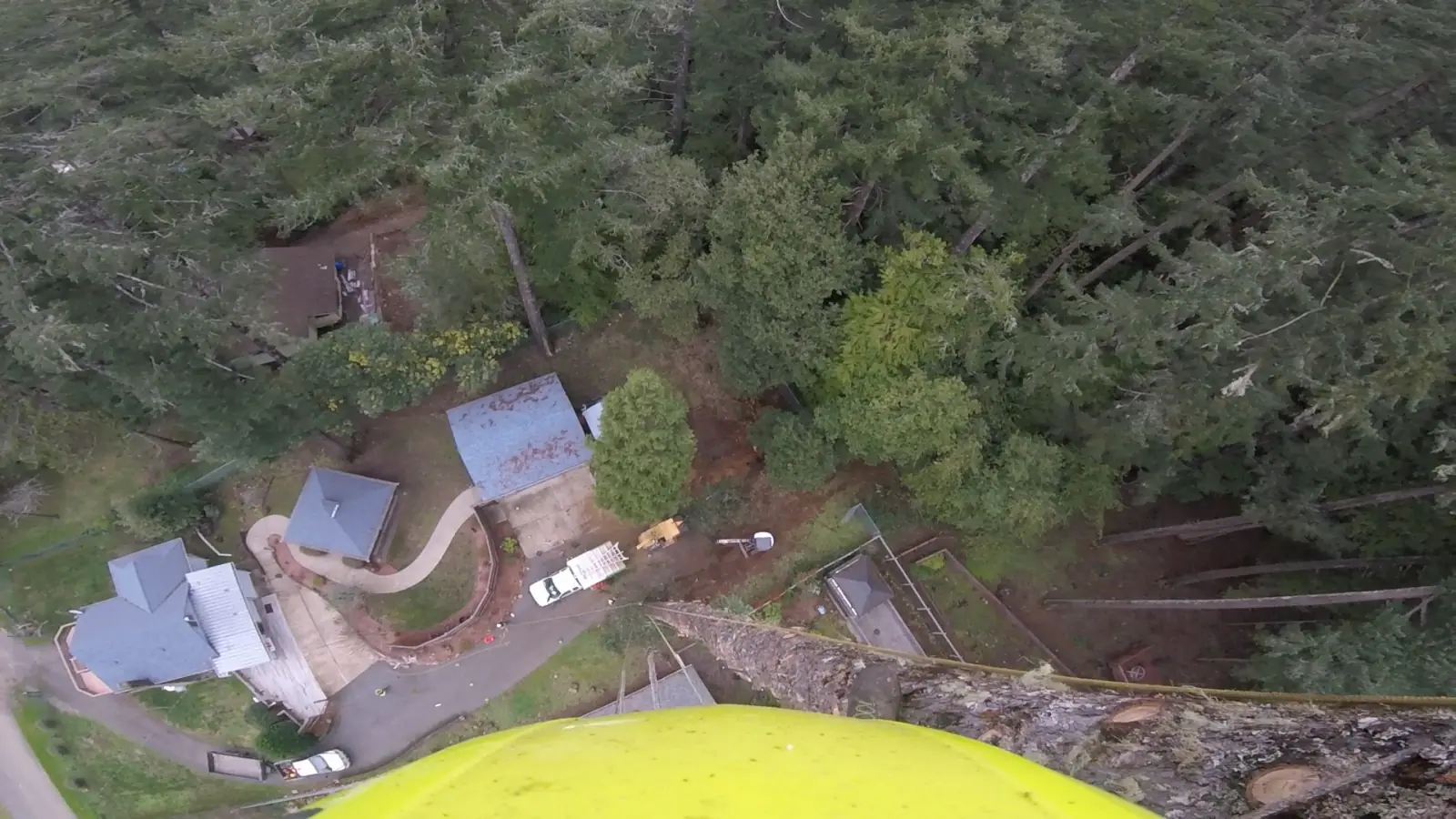
Everything that comes off is either dropped into a clear zone the crew below is managing, or lowered on a rope when there is a roof, a fence, or a garden underneath. At the base the limbs go straight to the chipper. Redwood and fir chip beautifully, and a lot of Arcata homeowners keep the chips for paths and beds.
Then the site gets cleaned. Needles and small debris get raked, the roof and gutters get checked if we were working over them, and the last thing we do is walk it with you.
Timing: when to trim conifers in Arcata
The good news about redwoods, firs, and spruce is that they are forgiving on timing. Unlike fruit trees or hardwoods, where the dormant season matters, conifer trimming for clearance and deadwood can happen most of the year. That said, there are a couple of local realities.
The first is storm season. The fronts that come through between late fall and late winter do their worst work on crowded, heavy crowns and dead limbs. Getting deadwood out and weight off before the first big blow is the cheapest storm insurance an Arcata homeowner can buy. So fall is a smart time to book.
The second is nesting season in spring. Big conifers host a lot of birds, and we look before we cut. If there is an active nest in the part of the tree you want worked on, the honest move is usually to do the rest of the job and come back for that section later in summer.
Signs your conifer needs a climber, not just a trim
Sometimes what a homeowner calls a trimming job is actually a hazard assessment, and the tree is telling you something bigger. These are the signals that mean get an arborist up in the tree, not just a saw on the low limbs.
- A dead or browning top. On a redwood or a fir, when the top third goes off color or bare, the tree is stressed below the surface. Sometimes it recovers. Sometimes it is the start of a decline that ends in removal, and you want to know which.
- A new lean, or a lean that got worse after a storm. Check the soil on the uphill side of the trunk. Lifted soil or a cracked root plate means the tree is moving.
- Fungus at the base. Conks or shelf mushrooms on the trunk or root flare mean decay inside. In our wet climate root rot moves fast on firs and spruce especially.
- Multiple tops on a redwood, especially if it was topped at some point. Those tops need to be evaluated for how well they are attached.
- Big dead limbs you can see from the yard. If you can see them, there are more you cannot.
- Cracks, seams, or a split where two stems meet.
None of these means the tree is coming down. They mean it needs to be looked at properly, and the trim you were planning might change based on what the arborist finds.
Redwoods next to foundations, driveways, and sewer lines
A question we get in the older Arcata neighborhoods and around the college is about redwood roots. Redwoods do not have a taproot; they spread a wide, relatively shallow root system. That means in a small yard the roots are under the driveway, the patio, and often the foundation. People worry the roots will crack things.
The honest answer is that redwood roots can lift a sidewalk or a driveway slab over decades, and they will find a leaking sewer line if one exists. They do not typically break a sound foundation. Trimming the crown does nothing about roots, and cutting major roots to protect hardscape can destabilize the tree, so that is not a casual decision. If roots are the actual concern, that is an arborist conversation about the specific tree, not a trimming job. We are glad to have it.
What about the neighbor's tree?
In Arcata a lot of the trees that worry people are not theirs. The redwood is on the neighbor's side, the limbs are over your roof. The general rule in California is that you can trim what overhangs your property, up to the property line, as long as you do not damage the tree. The practical rule is that it goes a lot better when the neighbors talk first, and better still when one crew does the whole tree properly rather than each side hacking at its half.
We do a lot of shared-tree jobs where two neighbors split one quote and the tree gets trimmed as a tree instead of as two halves. It is cheaper for both, and the tree ends up healthier.
What it costs, and what changes the number
We do not publish a price list for trimming because every tree is different, but we can tell you what moves the number so the quote makes sense when you get it. Height and size of the tree. How much of the crown needs work. Access: can the chipper get close, or does everything get carried out through a side gate. What is underneath: a trim over open lawn is faster than a trim over a glass sunroom. Whether we are lowering everything on ropes or can drop into a clear zone. And how much material we are hauling.
The quote is free and it is firm. When our arborist looks at your tree, you get a written number for the exact work described, and that is the number.
Leaving a tree alone is a real option
We will end where we started. A healthy redwood with good structure, reasonable clearance from the house, and no deadwood over anything that matters does not need anything from us. Big trees are not hazards by default. They are hazards when they have a defect, a target, and weather, and a lot of Arcata's redwoods have none of the first.
If you want to know which category your tree is in, that is exactly what a free assessment is for. Send us a couple of photos with the quote form, or pick a time on the booking calendar and an arborist will come stand under the tree with you. You will get a straight answer: trim this, watch that, leave the rest alone.