Stump Grinding in Eureka and Arcata: What Happens, What It Costs to Skip, and What Grows Back
A tree comes down and everyone is happy for about a week. Then the stump starts to bother you. It is in the middle of the lawn, or right where the new fence line goes, or two feet from the driveway where the car door hits it. On a small Eureka or Arcata lot there is no place a stump is not in the way.
Stump grinding is the fix, and it is simpler than most people expect. This guide covers how grinding works, how deep it goes, what happens to the chips, which local trees will fight back from the stump if you leave it, and the handful of situations where leaving a stump is actually the right call. It also covers what to do about the stump from a tree someone else took down years ago that you have been mowing around ever since.
How stump grinding works
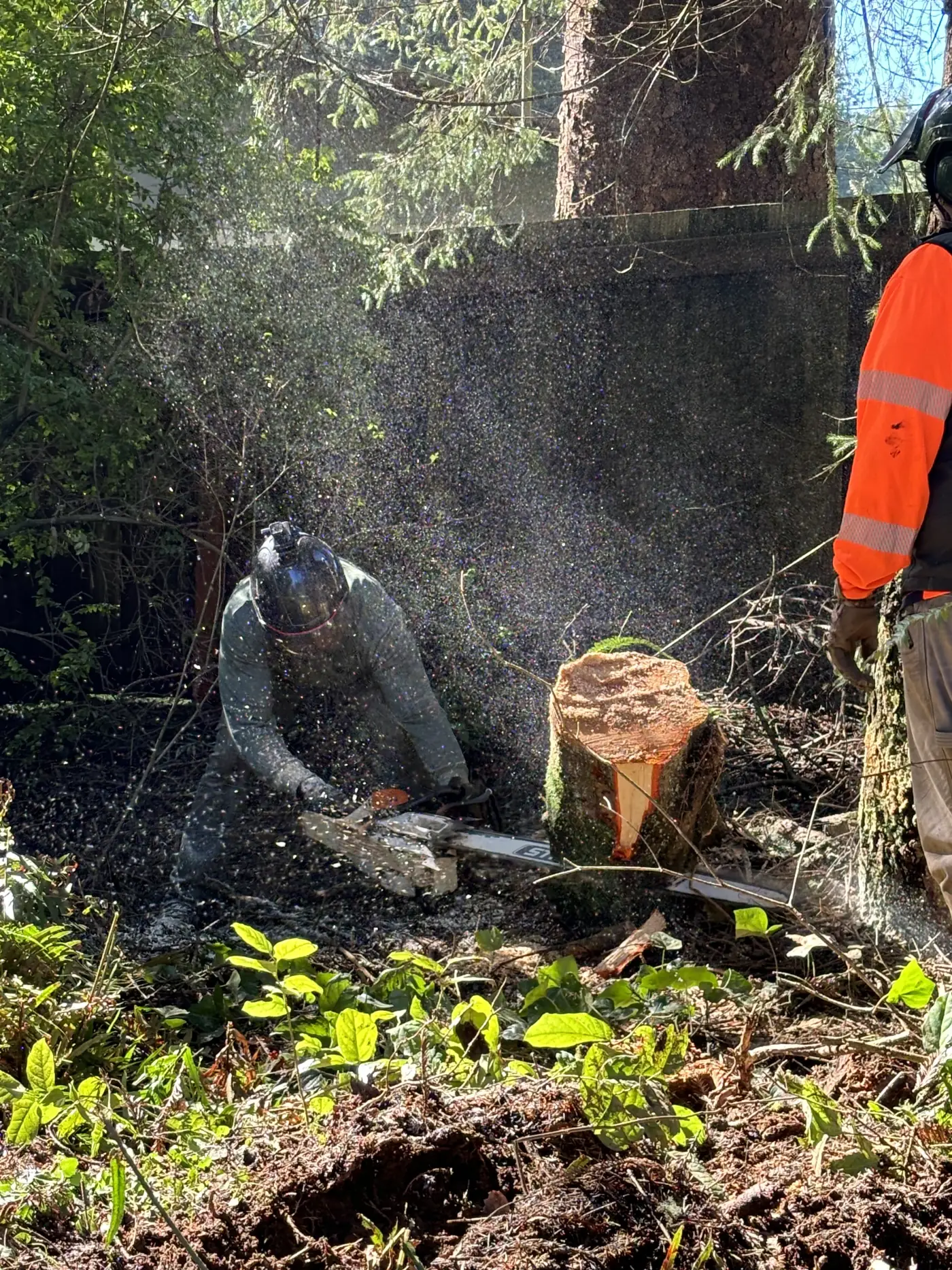
A stump grinder is a machine with a spinning cutter wheel studded with carbide teeth. The operator positions it over the stump and sweeps the wheel back and forth across the top, taking off a layer at a time. Each pass turns wood into chips, and the wheel keeps going down until the stump is below the surface. Then the operator moves out along the big surface roots, called the root flare, and grinds those down too, so you are not left with a ring of woody knobs around a hole.
There is no digging, no pulling, no backhoe. The stump is not removed so much as converted into a pile of chips sitting in a shallow hole where the stump used to be. That is why grinding works on lots where an excavator could never fit, and why it does almost no damage to the lawn or beds around the stump.
How deep it goes
The standard grind takes the stump down to somewhere around six to twelve inches below the surface. That is deep enough to lay sod, plant a garden bed, or put in a walkway over it. If you are planning to plant a new tree in the same spot, or set a fence post, or pour a footing, say so. We grind deeper for that, and it is easier to do it in one visit than to come back.
What grinding does not do is remove the whole root system. The roots that run out from a big tree under a lawn stay there. They rot in place over the years and that is fine. The reason to grind deeper or wider is if a root is going to be in the way of something specific, not because the roots are a problem on their own.
Access on Eureka and Arcata lots
The question we ask first on a stump call is the same one we ask on a removal: how do we get to it? On a corner lot with an open driveway, the grinder drives straight in. On a lot with a side-yard gate, it depends on the gate. We run grinders that fit through a standard gate opening, which covers most of the older neighborhoods in Eureka and the flats in Arcata. If the only way in is a three-foot opening between the house and the fence, or a set of steps, that changes the machine and the time, and we will tell you before we quote.
The other thing to look at is what is around the stump. Grinding throws chips, and while the machine has guards and the operator shields the work, we still cover windows, move cars, and keep people and pets inside during the grind. If the stump is against a foundation, a retaining wall, or a buried utility line, that changes how close the wheel can work. Which brings up the important one.
Underground utilities
Water, sewer, gas, electrical, irrigation, and low-voltage lines all run through yards in Eureka and Arcata, and a stump grinder cannot see them. Before grinding in a location where lines might be, we get utilities marked. It is free, it takes a couple of days, and it is not optional near the street side of a house. If you know where your irrigation and low-voltage landscape wiring runs, tell us, because the utility locate does not mark private lines.
What happens to the chips
A big stump produces a surprising volume of chips, because the grinder turns dense wood into loose material and the pile is much bigger than the stump was. Here are the options.
- Rake the chips back into the hole and mound them. This is the default. The chips settle over a season, and you can top-dress with soil and seed or sod when they drop.
- Haul the chips and backfill with soil. Cleaner and faster if you want to plant right away. It costs more because the chips go on the truck and soil comes off it.
- Use the chips as mulch. Stump chips mixed with soil are not great for beds right away, but if you have a path or a low-traffic area, they work fine.
Whichever you pick, know that a spot where a big stump was taken out with the grinder will settle for a year or two as the chips and the remaining roots break down. A little low spot is normal. Top it up and move on.
Which North Coast trees sprout back from the stump
This is the part that matters most for deciding whether to grind or leave it. Some trees, once cut, are done. Others treat a stump as an invitation.
Trees that sprout aggressively
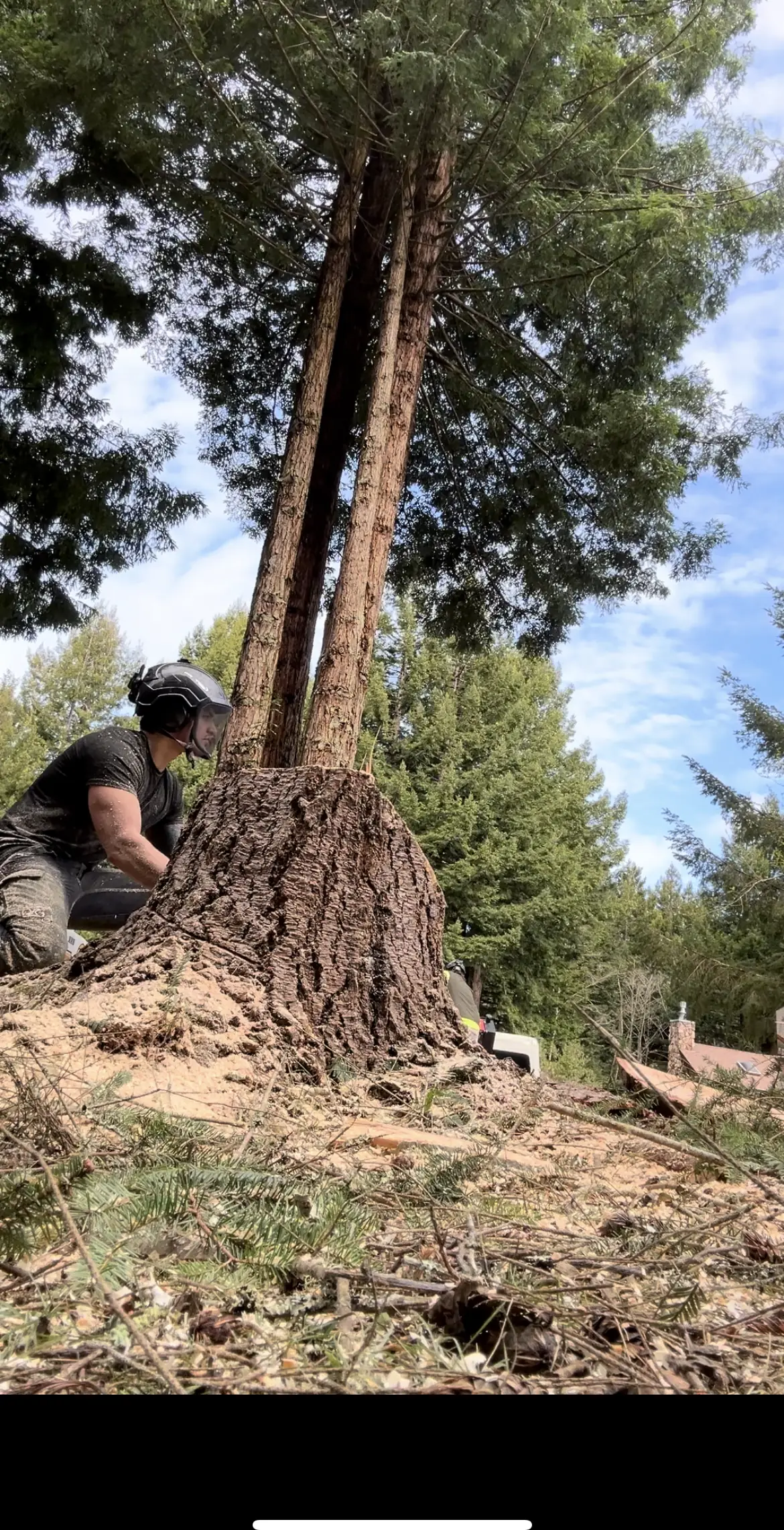
Coast redwood is the big one around here. A redwood stump throws a ring of new shoots from the base within months, and if you leave it, you will have a circle of young redwoods where the old one stood. Some people like that. Most people who took a redwood out of a small yard did not want six more. Eucalyptus is the same, and worse, because the regrowth is fast and weak. Willows, cottonwoods, alders, and most fruit trees will also send up suckers from a cut stump and from the roots around it. Sycamore and the various maples people plant in Eureka yards sprout too.
For these species, grinding is not just about the stump being in the way. It removes the living tissue the sprouts come from. A redwood stump taken well below the surface with the grinder with the root flare taken down mostly stops sprouting, though redwood being redwood, you may see a few shoots from the outer roots for a season. Those are easy to cut.
Trees that do not sprout
Douglas fir, Sitka spruce, grand fir, and most pines do not sprout from the stump. Monterey cypress does not either. If one of those came down and the stump is somewhere you can live with it, leaving it is a legitimate choice. It will rot slowly over years, host some fungus and beetles along the way, and eventually crumble. None of that is a problem in the back corner of a lot. It is a problem in the front lawn.
Old stumps and stumps from someone else's job
A lot of the stumps we grind are not from our removals. They are from a tree that came down five or ten years ago, cut off at knee height by a previous owner or a different company, and left. The good news is that an old, partly rotted stump grinds faster than a fresh one. The bad news is that an old stump is often hiding things: rocks that were thrown in against it, a chunk of concrete, an old fence post, wire, or the previous owner's attempt to burn it out. The operator goes slow on old stumps for that reason.
If you have a big old redwood stump that has been sprouting for years, there is usually a mass of young trunks growing out of it now. Those get cut first, then the whole stump complex goes through the grinder. It is more work than a clean stump, and worth doing once rather than cutting the sprouts every spring forever.
What it costs, and what moves the number
Stump grinding is priced by the stump, and the number mostly depends on the diameter of the stump measured across the widest part at the surface, including the flare. A small fruit tree stump is quick. A four-foot redwood stump with a big flare is a couple of hours of grinding and a lot of chips. Beyond size, the things that change the quote are access, how many stumps are on the property, whether you want the chips hauled and soil brought in, and how deep you need us to go.
The cheapest way to grind a stump is to have it done the same day as the removal, while the crew and the machine are already on site. If we are taking a tree down for you, ask about the stump when you get the quote. Adding it later means a separate trip, and a separate trip costs more.
When to leave a stump
We do not push grinding on every stump, because not every stump needs it. Leave the stump if it is a non-sprouting species in a spot that does not bother you. Leave it if you actually want the redwood sprouts as a hedge, which some people on bigger Arcata lots do. Leave it for a season if you are not sure what is going to happen in that part of the yard and want to make one decision instead of two. And leave it, at least for now, if it is on a steep slope where the roots are holding the bank, because removing the stump does not remove the roots but it does open up the surface.
If you want a stump taken out, it is a quick job and we are glad to do it. If you are not sure, ask when the arborist is out for something else and get a straight answer.
Stumps around Eureka, Arcata, McKinleyville, and Cutten
The Eureka crew handles stumps across Humboldt Bay: Eureka proper, Cutten, Myrtletown, the Arcata bottoms and hill neighborhoods, McKinleyville, and out to Blue Lake. Stump grinding is often bundled with a removal, but we also do stand-alone stump days where we hit several properties in the same neighborhood. If you and a neighbor both have stumps, mention it. It can bring the number down for both of you.
The short version
Stump grinding turns the stump into chips below the surface, with no digging and almost no damage to the yard. It goes deeper if you tell us what you are building or planting. Redwood, eucalyptus, willow, alder, and fruit trees sprout from the stump and should go through the grinder. Firs, spruce, pine, and cypress do not sprout and can be left if the spot allows. Get utilities marked, do it the same day as the removal if you can, and expect the spot to settle a little for a year.
Quotes are free. Send a photo of the stump with something next to it for scale, or pick a time on the calendar, and we will give you a firm number.