Brush Chipping and Hauling in Arcata and Eureka: Clearing the Pile Without a Dozen Dump Runs
Every property around Humboldt Bay has a pile. Sometimes it is the brush from last winter's storm that got dragged to the corner of the lot and left. Sometimes it is the blackberry and broom that took over the back third of an Arcata lot while nobody was looking. Sometimes it is what a weekend of cutting produced when a homeowner decided to take on the hedge, and then discovered that the hard part of cutting brush is not the cutting.
The hard part is getting rid of it. Brush does not stack, it does not fit in a truck, the transfer station charges by the load, and a pile of cut blackberry the size of a car is about four trips in a pickup if you can get it in at all. This guide is about the alternative: a crew with a chipper that turns the pile into a truckload of chips in a morning. It covers how chipping works, what can and cannot go through the machine, what the chips are actually good for, what hauling costs relative to doing it yourself, and the North Coast specifics on broom, blackberry, and storm cleanup.
How chipping works
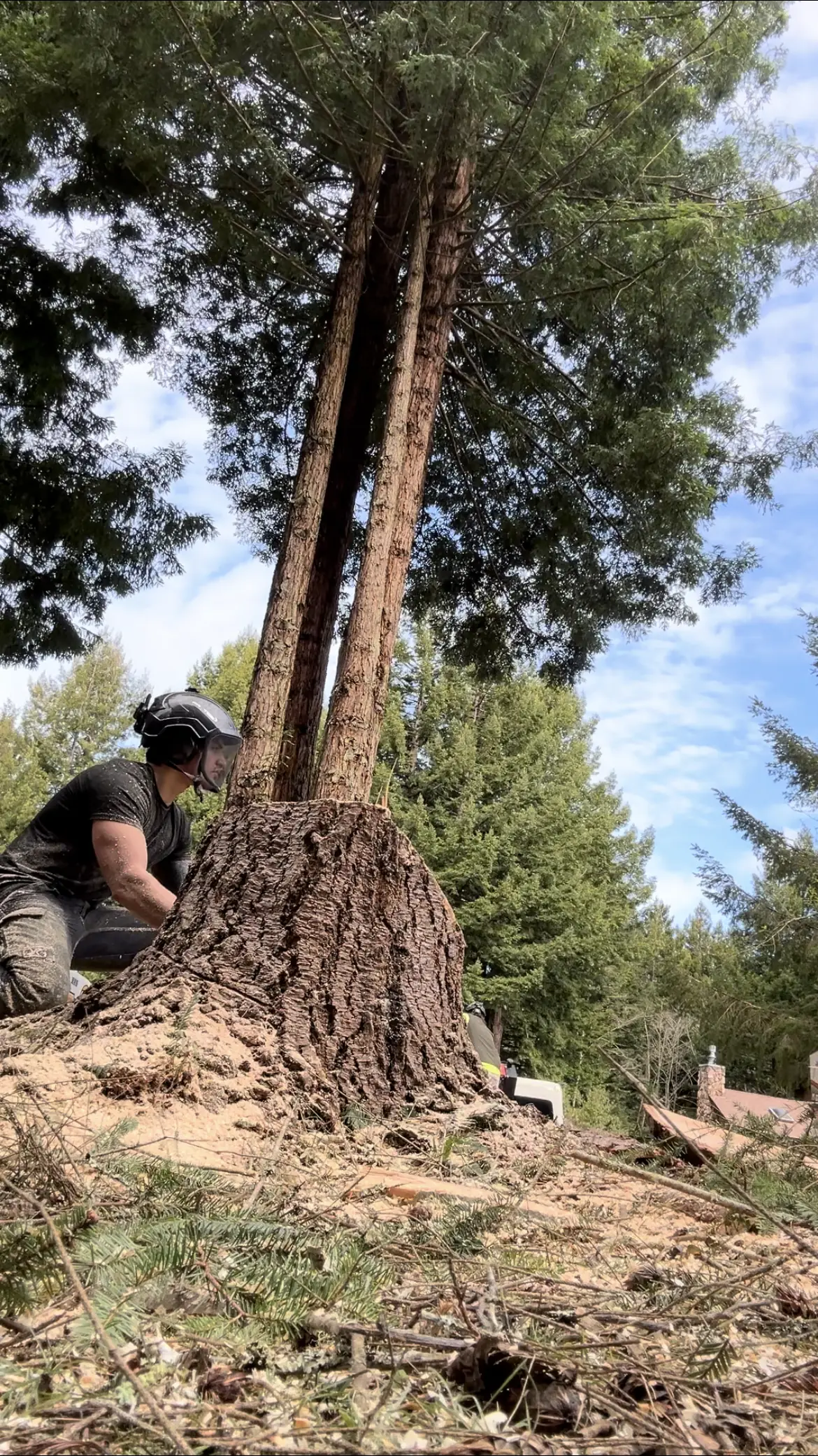
A brush chipper is a drum or a set of blades driven by a big engine, with a feed chute in front and a discharge chute behind that throws chips into a truck bed or a chip box. The crew feeds branches butt-first into the chute, the feed rollers pull them in, and the chips come out the back at high speed. A good crew with a good machine can turn a large pile of limbs into chips faster than it took to cut them.
The chipper we run handles limbs up to a reasonable diameter, which covers nearly everything on a residential lot. Bigger wood, the trunk sections from a removal, gets bucked into rounds and either left for firewood or loaded onto the truck. The result is a site with no brush, a truck full of chips, and a small stack of rounds if you want them.
What can go through, and what cannot
Most woody material chips fine: tree limbs, brush, hedge trimmings, bamboo, the woody stems of blackberry and broom. Here is what does not, and what we do with it instead.
- Vines, ivy, and long stringy material. English ivy and long blackberry canes wrap around the feed rollers and jam the machine. We handle them in bundles, and heavy ivy jobs are often hauled loose rather than chipped.
- Soil, rocks, and roots with dirt on them. Dirt dulls the blades fast and rocks destroy them. Root balls and stumps are not chipper material; they are grinder material.
- Lumber, fence boards, and anything with nails. No treated wood, no plywood, no old fence. It is unsafe for the machine and the chips are not usable.
- Palm fronds. Stringy, fibrous, and a mess. They get hauled.
- Leaves and grass clippings in bulk. Wet leaves do not chip, they clog. They get raked and hauled.
- Anything poison oak. We chip it if it is mixed in, but the chips are not usable and the crew handles it with care. Tell us if the pile has poison oak in it.
If your pile is mostly one of the things on the no list, the job is a hauling job rather than a chipping job, and it is priced by volume. Say what is in the pile when you ask for a quote and there are no surprises.
What the chips are good for
Fresh wood chips from a mixed brush pile are one of the most useful things you can put on a North Coast property, and a lot of homeowners have us leave them instead of hauling them. Uses, in order of how well they work:
Paths and open areas
A few inches of chips on a garden path, a dog run, a play area, or a muddy stretch between the house and the shed does more than gravel for less. Chips from conifers and mixed hardwoods last a couple of seasons before they break down and need topping up.
Around trees and under shrubs
A wide, shallow ring of chips around a tree, kept a few inches back from the trunk, holds moisture, suppresses weeds, and breaks down into good soil. This is close to what a forest floor does naturally. Under established shrubs it does the same.
Not in vegetable beds
Fresh chips tie up nitrogen as they break down, so a thick layer dug into a vegetable bed is a bad idea. On top of a bed as a mulch, they are fine. Composted for a year, they are great.
Not redwood or eucalyptus in beds
Redwood chips take a long time to break down and eucalyptus chips have oils that suppress other plants. Both are fine on paths and both are poor under anything you want to grow.
If you want the chips, tell us where to put them. The chipper discharge can be aimed at a pile in a specific spot, which saves you moving them later.
Broom, blackberry, and the Arcata back lot
Two plants account for most of the brush-clearing calls we get around the bay. Both are invasive, both take over an unattended lot in a few years, and both come back if the job is done halfway.
Scotch broom
The yellow-flowered shrub that lines every road cut and empty lot in Humboldt. Broom is easy to cut and chips fine. The problem is the seed bank; a mature stand has been dropping seed for years and the soil is full of it. Cutting the stand is step one. Pulling the seedlings that come up over the next two or three springs, while they are small, is what actually gets rid of it. We clear the standing broom and tell you what the follow-up looks like.
Himalayan blackberry
The thorny thicket that eats fences, sheds, and the back third of Arcata lots. Blackberry is cleared by cutting the canes back to the base and then dealing with the crowns, the woody root masses that will resprout. On small patches we dig or grind the crowns. On big thickets, cutting and then cutting the regrowth again in a few months is how it gets worn down. The canes chip, but they are stringy and heavy, and a big blackberry job is as much hauling as chipping. Wear thick gloves if you try any of this yourself. Better, do not.
Storm cleanup
After a winter front, the yards around Humboldt Bay are full of limbs and blowdown. The storm cleanup version of this job is a crew coming through to cut up what is down, chip it, haul it, and rake the site. It is usually a half day, it is usually cheaper than people fear, and it is a lot faster than doing it by hand. If a tree came down and is still hanging in another one, or resting on something, that is a hazard job first and a cleanup job second, and we handle it in that order.
Land and lot clearing
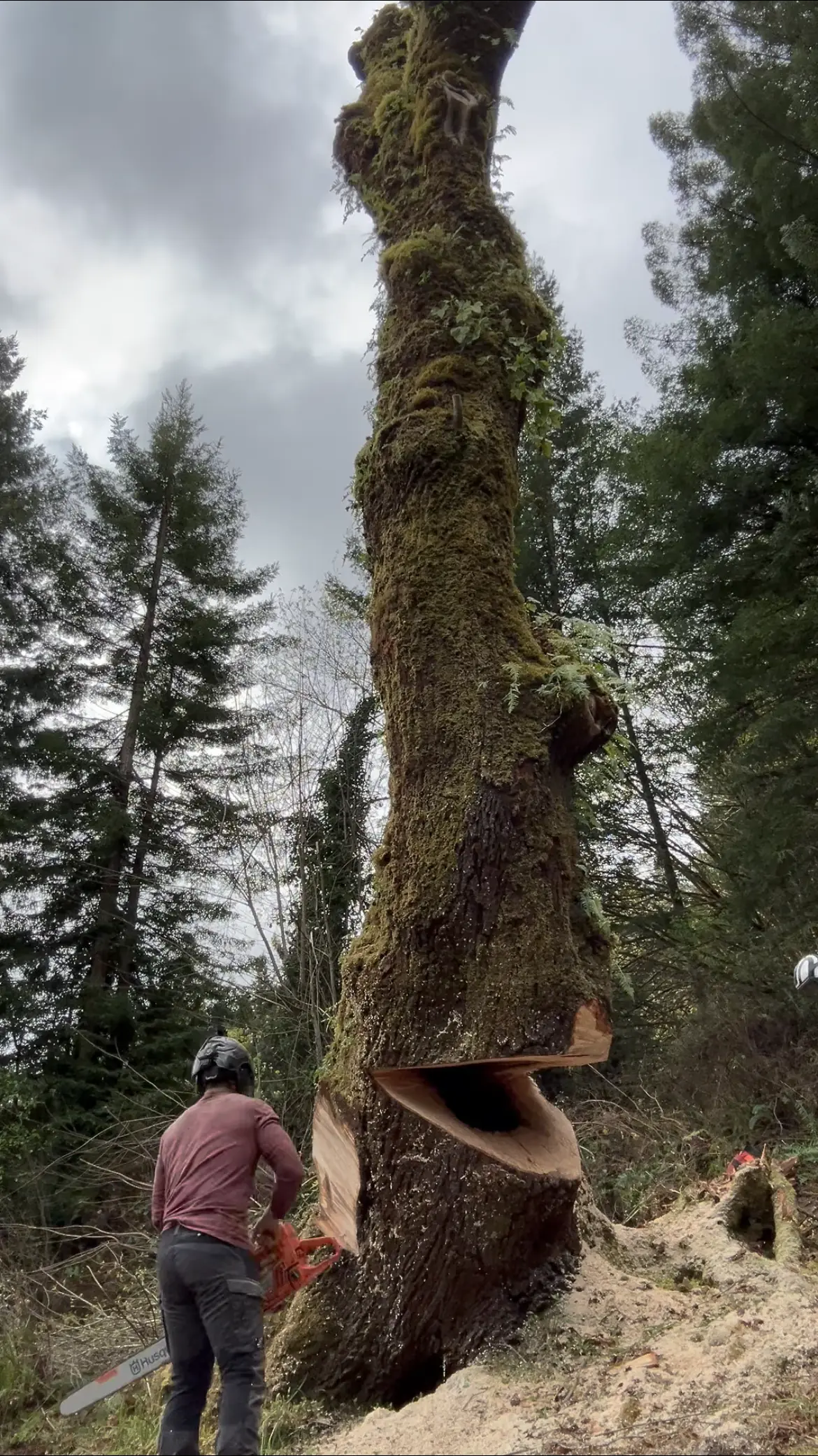
The bigger version of the brush job is clearing an overgrown lot, a new building site, or the back acres of a rural property. That is a chipper plus saws plus, on bigger jobs, a machine to move material. The approach is the same, scaled up: cut, drag, chip, haul, and leave a site you can walk across. We do it around Eureka and Arcata on everything from a single overgrown lot to several acres, and the quote depends on what is growing there and how dense it is. If there are trees to keep on the site, we mark them first.
How to stack a pile so it chips fast
If you are cutting the brush yourself and having us chip and haul it, a little organization saves real money, because the crew is paid by the hour and a tangled pile takes twice as long as a tidy one. Stack limbs and canes with all the cut ends facing the same direction, toward where the chipper will sit. Keep the pile within reach of a spot the truck can get to, ideally next to the driveway or the street. Do not mix in soil, rocks, roots, boards, or garbage. Keep leaves and grass in a separate pile, or bag them.
Keep the pile off the lawn if you can. A big pile of green brush sitting on grass for a few weeks kills the grass under it. A tarp, the driveway, or a bare corner is better. And do not pile it against the house, the fence, or the woodpile, where it becomes a fire and rodent problem. A well-stacked pile next to the driveway is a half-hour job. The same material scattered across the back of the lot is a half day.
Doing it yourself versus a crew
Some brush work is a fine weekend project. A small pile of pruning from a couple of fruit trees fits in a truck and the transfer station takes it. Here is the honest math on when it stops being worth it.
A pickup holds a surprisingly small amount of brush, because brush does not pack. A pile that looks like two loads is usually four or five. Each load is the drive, the fee, the unloading, and the drive back. A rented chipper from a tool yard is another option; the small ones are slow, they jam on anything stringy, and by the time you have rented, trailered, run, and returned it, you have spent most of a day.
A crew with a commercial chipper does a pile that would take you a weekend in a couple of hours, hauls everything, and rakes the site. For anything bigger than one truckload, it is usually cheaper once you count your time and the fees, and it is always faster.
What the job costs, and what moves it
Chipping and hauling is priced by the volume of material and the time on site. Things that raise the number: the pile is stringy, wet, or mixed with dirt; the pile is far from where the truck can park; there is poison oak; the material has to be hauled loose rather than chipped. Things that lower it: the pile is stacked with the butts facing one direction, it is close to the driveway, you keep the chips, and it is bundled with other work like a removal or trimming that has the crew on site anyway.
If you are having a tree trimmed or removed, the brush from that job is already in the quote. If you also have a pile in the corner from last year, mention it, and it gets done the same day for far less than a separate trip.
Arcata, Eureka, McKinleyville, Cutten, and Blue Lake
The Eureka crew covers the bay from Blue Lake and McKinleyville down through Arcata, Eureka, Cutten, and the neighborhoods south. Chipping days often run through several properties in the same area, so if you have a neighbor with a pile, mention it. We can quote both and the trip is shared.
The short version
A crew with a chipper turns a pile into a truckload of chips in a morning. Woody brush and limbs chip; vines, dirt, lumber, and leaves get hauled instead. Keep the chips for paths and under trees, not in vegetable beds. Broom and blackberry need follow-up after the first clearing. Storm cleanup is a half day. For anything bigger than one truckload, a crew is cheaper than the dump runs once you count your time.
Quotes are free. Send a photo of the pile with the quote form, or pick a time on the calendar, and we will give you a firm number.