Eucalyptus on the North Coast: Why It Is a Problem, When to Remove It, and How It Comes Down
There is a particular kind of tree on the North Coast that people learn to recognize by the mess under it. Long strips of shed bark, a carpet of hard little seed caps, leaves that smell like cough drops when you crush them, and a trunk that goes up and up with almost no taper. Blue gum eucalyptus was planted all over Humboldt Bay and the Eel River Valley a century ago, for windbreaks, for firewood, for lumber that never worked out, and for shade, and it has been growing ever since. Some of the biggest trees in Eureka, Arcata, and Ferndale are eucalyptus.
It is also the tree we get the most worried calls about, and for good reason. This guide explains what makes eucalyptus different from the conifers and hardwoods around it, how to judge whether one near your house is a problem, what the options are short of removal, and what it takes to remove a big one when it has to go.
What makes eucalyptus different
Most of the big trees on the North Coast are trees that evolved here, in this weather, and they behave predictably. Blue gum is from Tasmania and southeastern Australia, and it behaves like a tree from a place with a different climate, different soil, and a different relationship with fire.
It drops limbs
Eucalyptus sheds branches, including large live branches, without warning and without an obvious cause. It happens in calm weather on hot days, it happens in wind, and it happens on trees that look perfectly healthy. The wood is heavy and the limbs are long. There is no reliable way to predict which limb or when, which is why a big eucalyptus over a house, a driveway, a play area, or a parking space is a different kind of risk from a fir in the same spot.
It grows fast and gets enormous
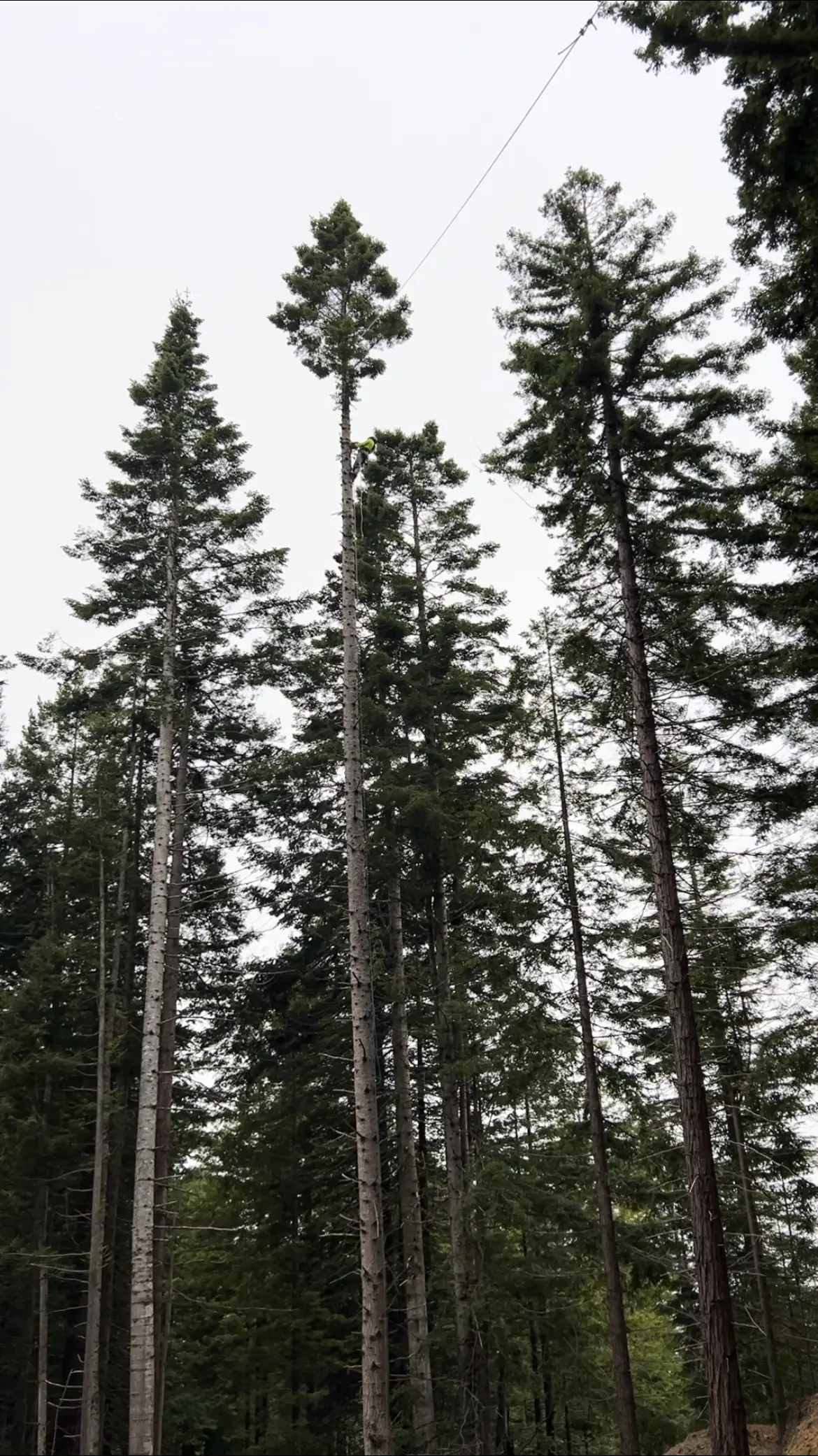
A blue gum planted as a windbreak seedling can be a hundred and fifty feet tall in the lifetime of the person who planted it. The trunk is dense and the crown is heavy, and the root system is often shallower and less anchored than the height suggests, especially in the wet winter soil of the valley. Whole-tree failure in wind is common on saturated sites.
It burns
The bark it sheds, the leaves it drops, and the oils in both are among the most flammable material on any property. A eucalyptus near a house is the first thing on the list in any defensible space plan.
It sprouts
Cut a eucalyptus and the stump throws a ring of fast, weak shoots within months. They are poorly attached and they grow into a hazard of their own. Eucalyptus removal is not finished until the stump is run through the grinder or treated.
How to judge the eucalyptus near your house
Not every eucalyptus has to come out. A blue gum in the back corner of a big lot with nothing under it, or one in a row along a field edge, may be fine to leave and manage. The questions are about targets and condition.
- What is under the crown? If the answer is the house, the neighbor's house, the driveway where cars park, the deck, the kids' play area, or the road, the tree is a hazard by location regardless of health. That is the honest starting point.
- How big is it, and how close? A mature blue gum within its own height of a structure can reach it if it fails whole. Most of the big ones in Eureka and Arcata neighborhoods are within a house length of several houses.
- Has it dropped limbs before? Look under it. Big limbs lying under it, or fresh tear-outs on the trunk where limbs let go, are the tree telling you what it does.
- Is there a lean, and has it changed? Eucalyptus on wet sites lean and keep leaning. A lean toward the house that has increased is a removal conversation.
- Is the crown thin or dead at the top? Dieback in a eucalyptus crown is often a sign of root problems below, and a tree with a compromised root plate is the one that goes over in the next big storm.
- Has it been topped? Many eucalyptus around the bay were topped decades ago, and the regrowth from those cuts is now huge and attached only to the outer wood of the old stubs. Those are the trees that lose entire tops.
If a couple of those come up yes, get an arborist to look at it. If most of them do, the answer is probably already clear.
Options short of removal
For a eucalyptus you want to keep, or one that is not an immediate hazard, there is real work that reduces risk.
Deadwooding and hazard-limb removal is the baseline. Climbing the tree and taking out dead limbs, hangers, and the limbs with visible cracks or tear-outs at the union gets rid of the most likely failures. It does not stop a healthy limb from dropping, but it removes the ones that are already on their way.
Crown reduction, done properly, shortens the longest and heaviest limbs back to laterals, which takes leverage off the unions and reduces what the tree can hit. It has to be done with care. Eucalyptus responds to heavy cutting with heavy regrowth, and a crown reduction that takes too much turns into a topping with all the problems that brings.
Regular inspection matters more with this species than with any other. A eucalyptus near a house should be looked at every couple of years by someone who knows what to look for. That is cheap insurance.
What removal involves
A big blue gum next to a structure is one of the harder removals we do, and the reasons are worth understanding.
It is heavy
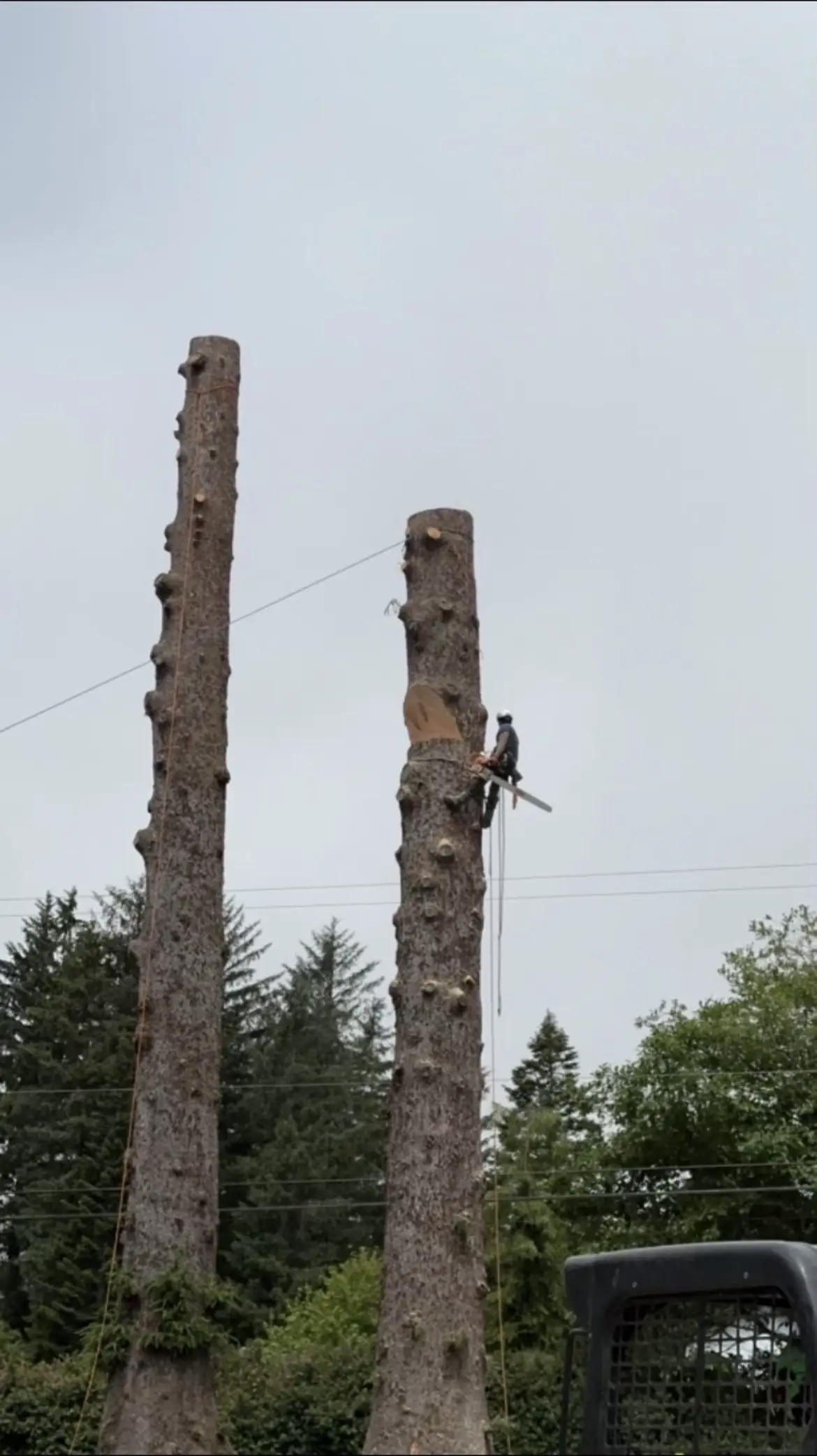
Eucalyptus wood is dense, and a mature trunk holds a tremendous amount of weight. Every piece that comes off a eucalyptus near a house is rigged and lowered, and the pieces are cut smaller than they would be on a fir of the same size because the rigging has to hold them. That means more cuts, more lowering, and more time.
It is unpredictable to cut
The wood in a big eucalyptus is often under internal tension, and it can split, barber-chair, or pinch a saw in ways that a straight-grained conifer does not. Climbers who work eucalyptus regularly read the wood before every cut. It is not a tree for a crew that is guessing.
The bark and the litter
Before work starts, the deep litter of bark strips and leaves around the base gets cleared so the crew is not working on a slick, uneven surface that hides holes. On big trees that is a job in itself.
Cranes on the tightest lots
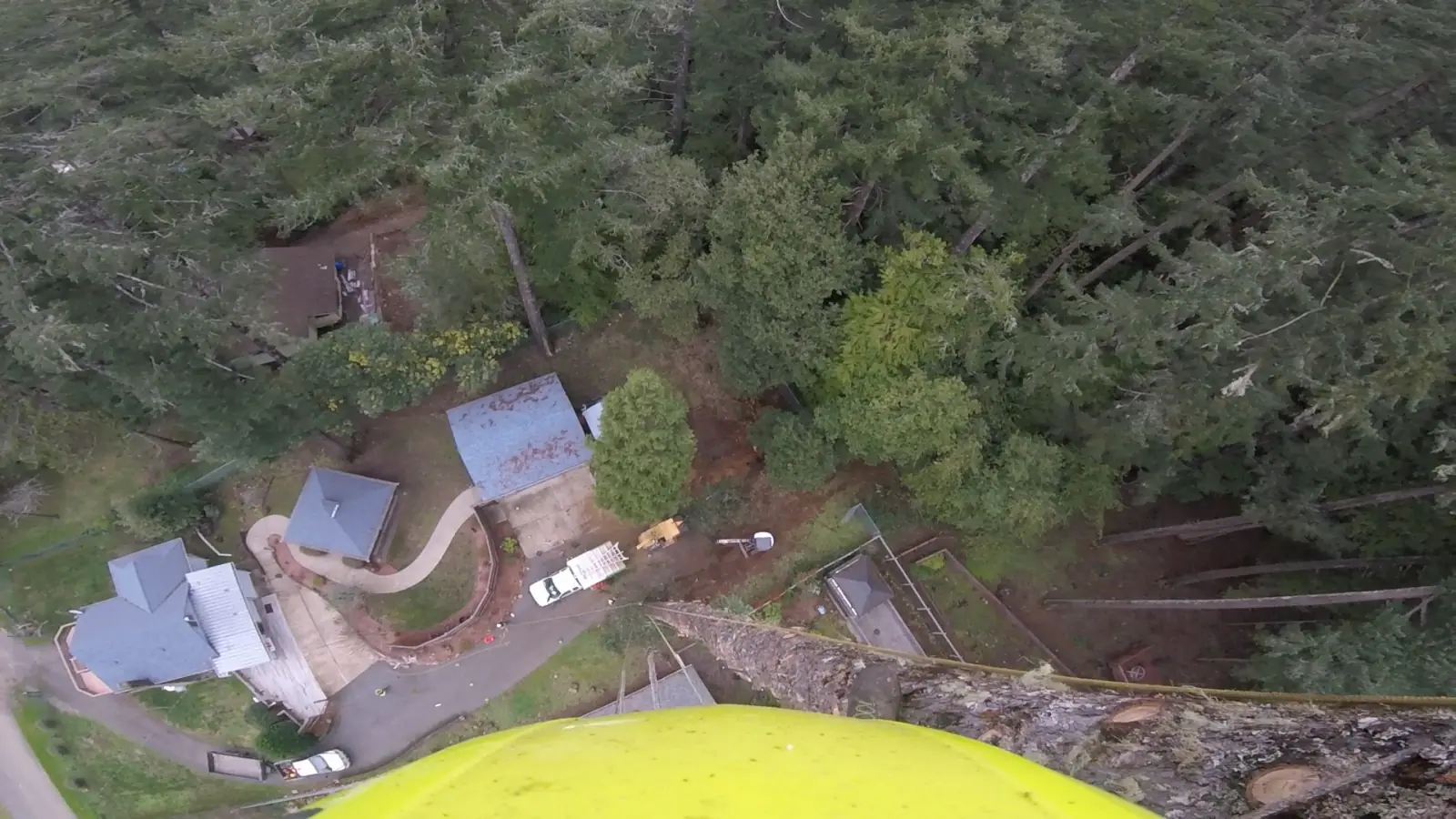
On some Eureka and Arcata lots, where a giant eucalyptus is surrounded on all sides and there is no space to lower pieces, a crane is the safest way to remove it. Pieces are cut, lifted straight up and out over the house, and set down on the street. It costs more per hour and less per hour of danger. We tell you when a job is a crane job, and why.
The stump
The removal ends with the stump taken below the surface with the grinder and the root flare taken down, because otherwise the stump sprouts. On a big eucalyptus this is real grinding, and it is part of the quote from the start.
What happens to the wood
Eucalyptus is good firewood once it is seasoned, and it takes a long time to season, often two summers. It is hard to split by hand and it checks and twists as it dries. If you burn wood and have a place to stack it, the rounds are worth keeping. If not, we haul them. The brush and bark chip fine, but eucalyptus chips are not ideal mulch on beds because of the oils, so most people have them hauled rather than spread.
Eucalyptus and the neighbors
Because blue gums are so big, the tree that worries you is often on someone else's property, and the crown is over yours. The general rule is that you can trim what overhangs your side as long as it does not harm the tree, but with a eucalyptus, cutting back the limbs on one side can unbalance the crown and make things worse. The better path, and the one we see work over and over in Eureka and Arcata, is for the neighbors to talk and split one job that deals with the whole tree properly. We are glad to do the assessment with both owners present.
Where we see it most
The Eureka crew sees eucalyptus all around the bay: Eureka's older neighborhoods, the edges of Arcata, the bottoms toward McKinleyville, and the old windbreak rows along the farms. The Fortuna crew handles the valley, where the rows around Ferndale and the farms toward Rio Dell hold some of the biggest blue gums in the county. Either crew can assess a eucalyptus and tell you honestly which category it is in: manage it, watch it, or take it down.
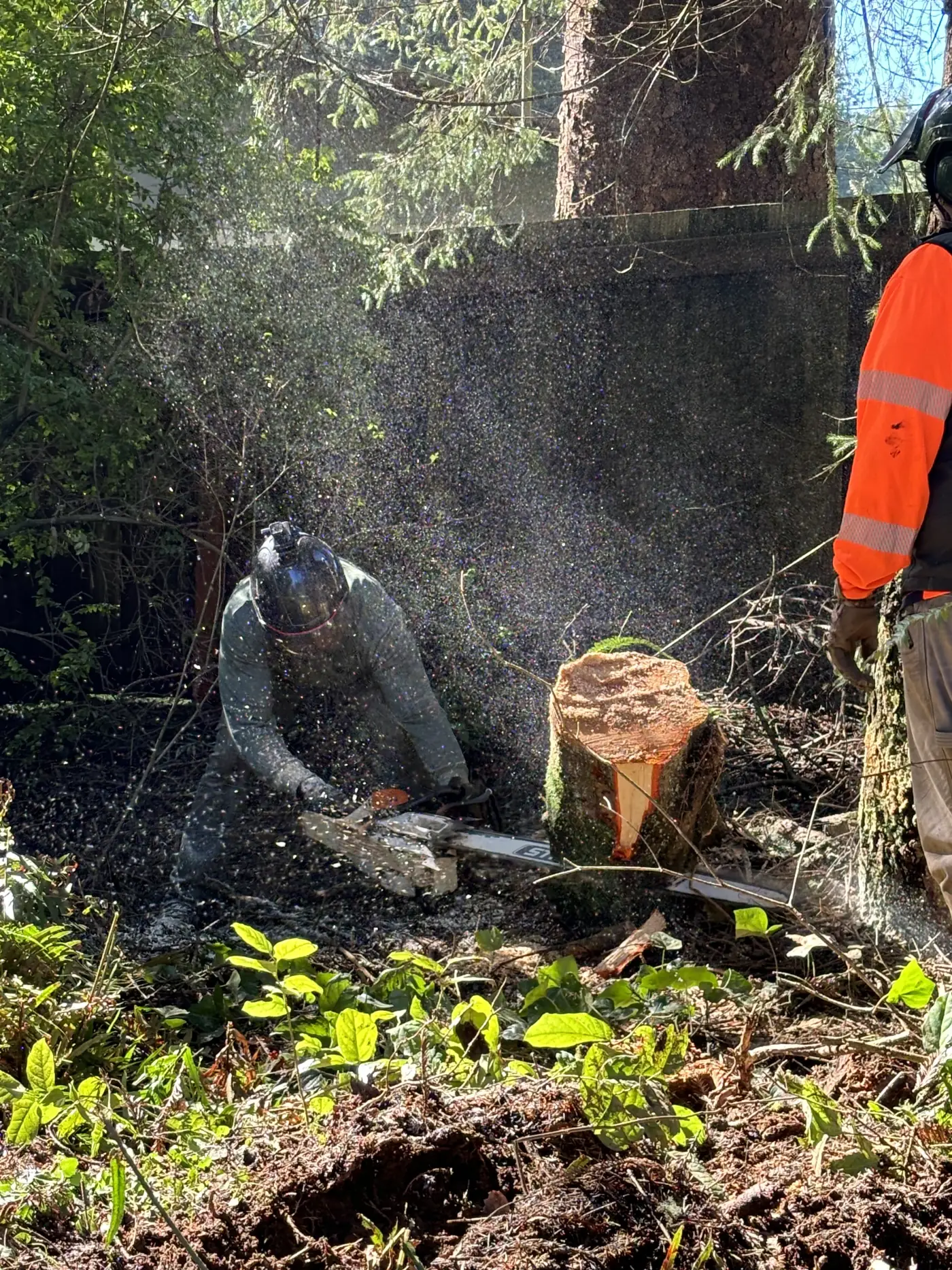
After the removal: what to plant instead
A big eucalyptus coming out leaves a hole in the yard and often a hole in the wind protection or the privacy it was giving. People ask what to put back. The honest answer is almost anything native does the job better in the long run. Coast redwood grows fast, stands up to wind, does not drop limbs the way blue gum does, and is close to fireproof. Sitka spruce and shore pine handle salt air near the bay. Monterey cypress is not native but it is a reasonable windbreak tree if you accept that it, too, gets big. For privacy on a small lot, a mixed hedge of wax myrtle, coffeeberry, and ceanothus fills in within a few years and never needs a climber.
What we would not do is plant another eucalyptus, or leave the stump and let the sprouts become the new screen. The sprouts grow fast and look like a hedge for a while, but every one of them is a weakly attached trunk on an old root system, and in ten years you have a thicket of hazards where you had one. Grind the stump, plant something that belongs here, and give it a couple of seasons. We do the planting as well as the removal, and a job that ends with the right tree in the hole is a better job.
The short version
Eucalyptus drops limbs without warning, grows huge on shallow roots, burns hot, and sprouts from the stump. Judge the one near your house by what is under it and what condition it is in. Deadwooding, careful reduction, and regular inspection can manage a tree you want to keep. When one over a structure has to come out, it is heavy, technical rigging work, sometimes a crane job, and it ends with the stump taken down with the grinder.
Assessments are free, and so are quotes. Send a photo with the quote form or pick a time on the calendar, and an arborist will come look.