What Drives the Cost of Tree Work in Eureka, Arcata, Fortuna, and Ferndale
The most common question we get, before anyone has looked at the tree, is what it is going to cost. The honest answer is that we do not know until we see it, and any tree service that gives you a number over the phone for a tree they have not seen is guessing. But that answer is not much use to a homeowner trying to figure out whether a job is a few hundred dollars or a few thousand, so this guide is the next best thing.
It walks through everything that moves the number on a tree job in Eureka, Arcata, Fortuna, and Ferndale, in the order it matters. When you get a quote from us or from anyone else, you should be able to look at it and understand why it says what it says. And when two quotes for the same tree are far apart, you should be able to figure out what one of them is leaving out.
The one thing that matters most: time
Almost everything on this list comes back to one number: how many crew hours the job takes. A crew is a climber or two, a crew below the climber, a chipper, a truck, and the insurance and equipment behind them. Every hour that crew is on your property costs about the same, whether they are working on a small tree or a big one. So what moves the price is what moves the hours. Keep that in mind and the rest of this makes sense.
Size of the tree
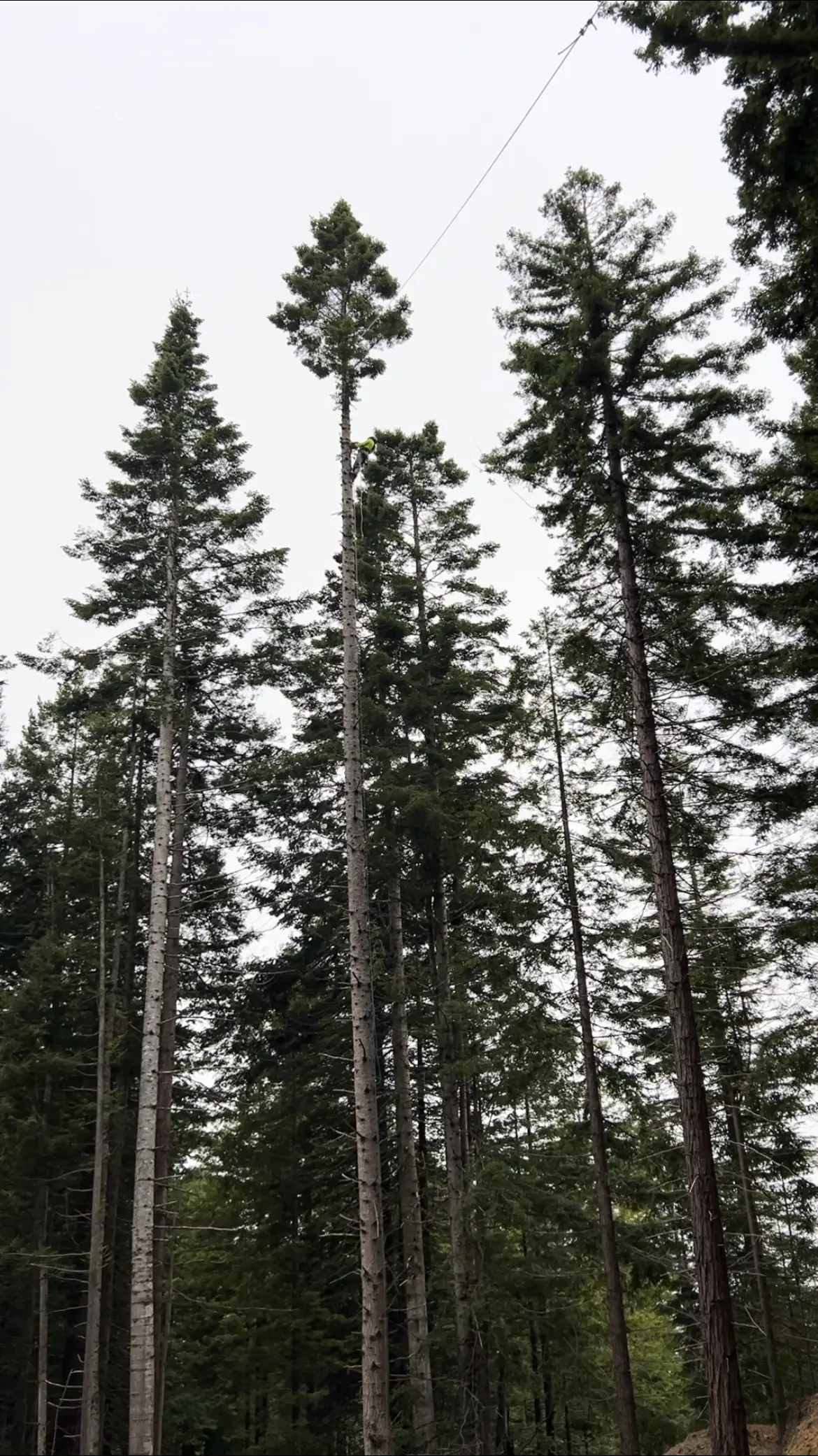
This is the obvious one, and it is less linear than people expect. A tree twice as tall is not twice the work. Height adds climbing time, but the real jump comes from the diameter of the trunk and the weight of the limbs. A forty-foot plum is a couple of hours. A hundred-foot Douglas fir of the same height as its neighbors but with a trunk you cannot reach around is a full day or more, because every piece is heavy, every piece is rigged, and the volume of wood coming down is enormous.
Species matters here too. Eucalyptus and cypress are dense and heavy for their size. Redwood is lighter than it looks. Alder and cottonwood are brittle and have to be handled carefully. The arborist is estimating pounds and pieces, not just feet.
What is underneath and around it
This is the factor that most surprises people and most separates a city lot from a rural one. A tree in an open field with nothing in any direction can be felled in one piece and bucked up on the deck. That might be two hours. The same tree in a Eureka side yard, with a house on one side, a fence on the other, a greenhouse behind it, and a garden under it, has to come down piece by piece with every piece lowered on a rope. That might be a full day. Same tree, five times the hours.
Everything that has to be protected adds time: roofs, decks, fences, gardens, hardscape, pools, the neighbor's property, and above all, overhead lines. A tree near utility lines is a different job with a different plan, and sometimes the utility has to be involved before anything happens.
Access
How close can the chipper and the truck get to the tree? On a corner lot with a wide driveway, the answer is right next to it, and every limb goes from the rope to the chipper in one carry. On a lot where the only way in is a three-foot gate between the house and the fence, every piece is carried by hand, or moved with a small machine, the length of the property to a chipper on the street. That can double the crew below's time on a big tree.
Rural properties have their own access question, which is the driveway. A chip truck cannot get up every ranch road above Fortuna, and when it cannot, material gets dragged or the plan changes. Tell us about the road when you call.
Rigging, cranes, and technical work
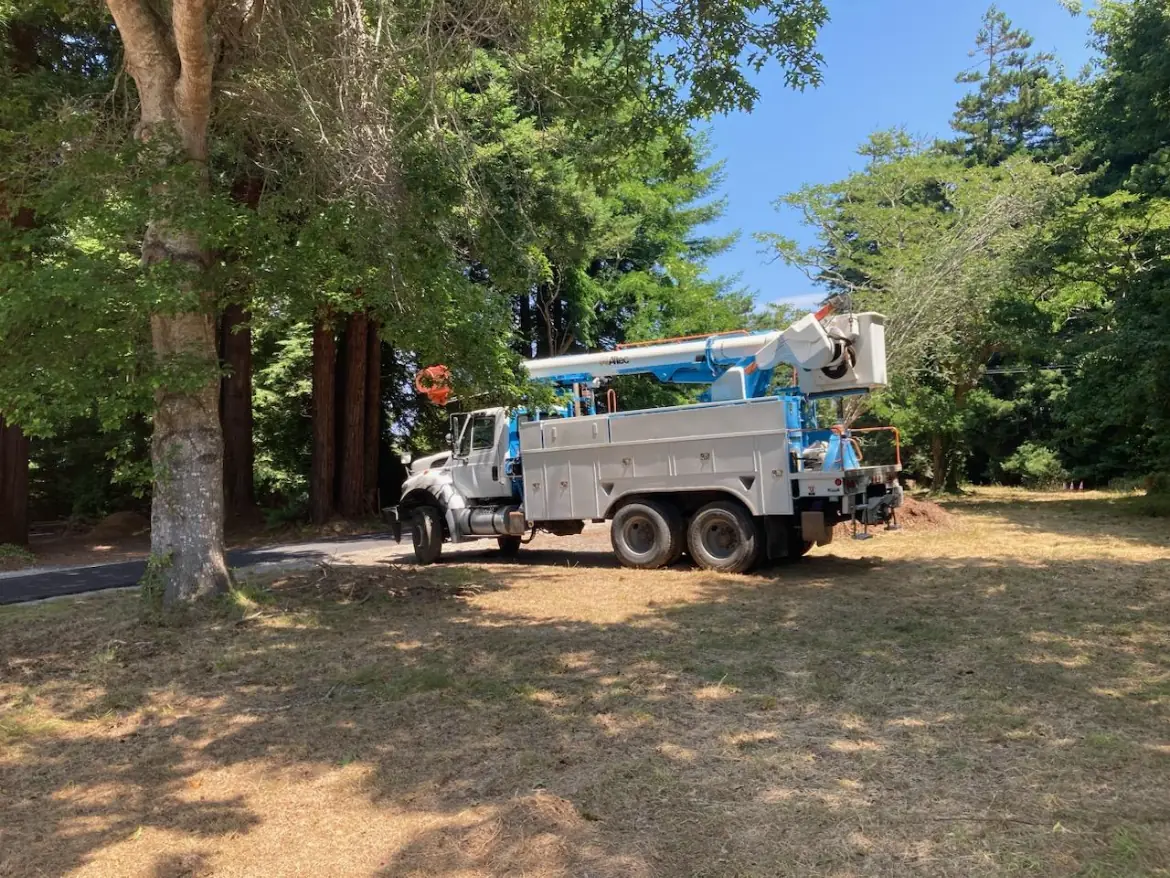
Some trees need more than a climber and a rope. A big tree with internal decay that cannot be climbed safely. A tree so surrounded by structures that there is no room to lower pieces. A tree leaning hard over a house. These become crane jobs, where pieces are lifted straight up and out, or jobs that need specialized rigging. A crane is expensive per hour and it makes the whole job faster and safer, so the number goes up and the risk goes down. We tell you when a job is a crane job and why, and it is never a surprise on the invoice.
What happens to the wood
Hauling is real work and real cost. The choices, from least to most expensive:
- Leave everything: the brush is chipped and the chips stay, the big wood is bucked into rounds and left. Least hauling, lowest number. Works if you have a place for the chips and want the firewood.
- Chip and haul the brush, leave the rounds. The most common choice. You get the firewood, we take the mess.
- Haul everything. The cleanest result. A big tree is several truckloads of material, and the number reflects it.
- Leave logs long for milling. Sometimes free, sometimes cheaper, because we cut fewer pieces. Only works on trees worth milling and lots where a log can be moved.
Stumps
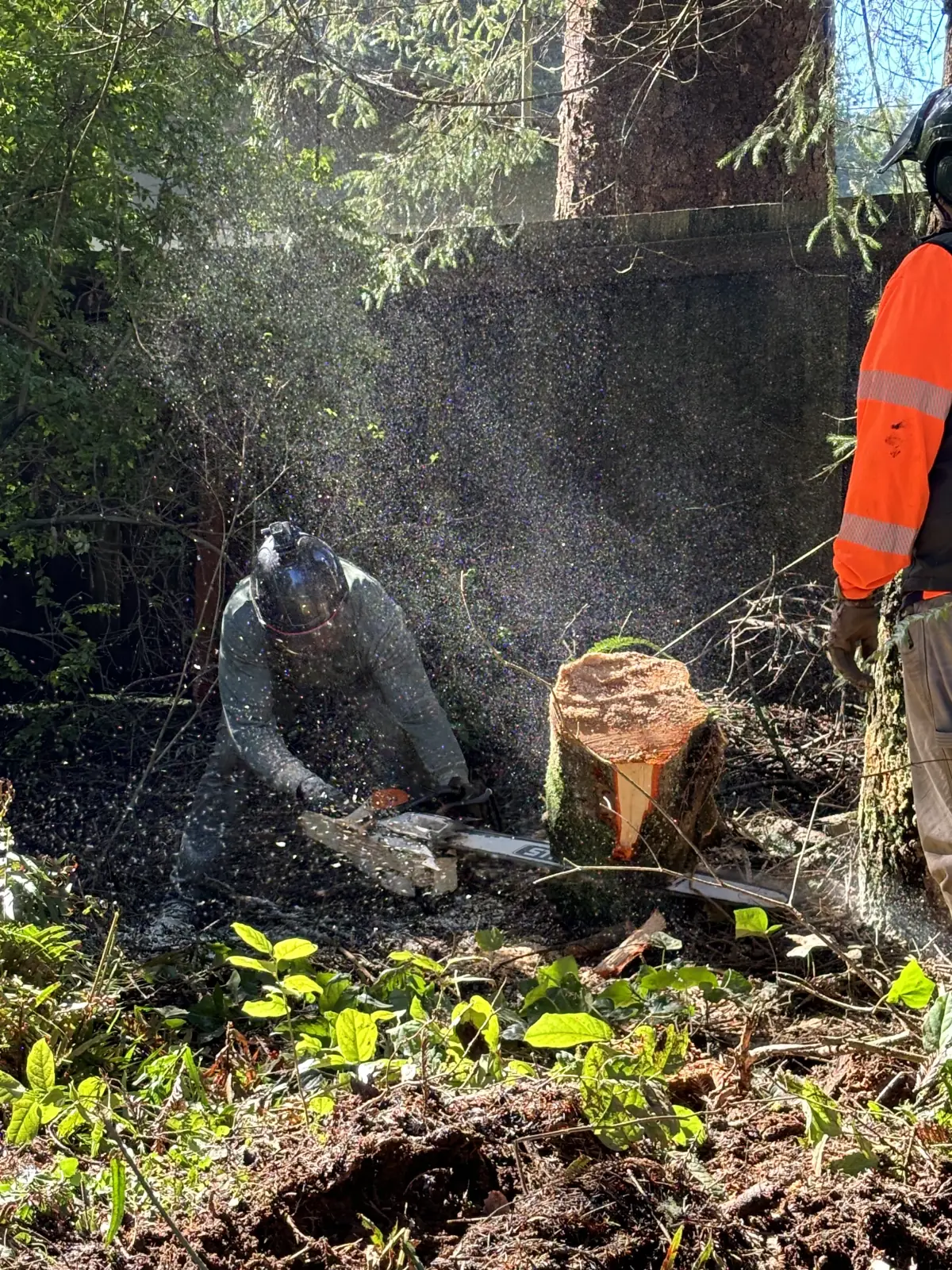
Stump grinding is priced separately, by the diameter of the stump including the root flare. It is cheapest when done the same day as the removal, because the machine and crew are already there. Adding it later is a separate trip. If you are going to want the stump gone, say so at the quote.
Trimming versus removal
A common assumption is that trimming a tree is always cheaper than removing it, and for a single visit that is usually true. But trimming a big tree properly is climbing work through the whole crown, and on a large conifer it can be most of a day. Over years, a tree that needs trimming every two or three years to stay safe over a house can cost more than a single removal would have. That is not an argument for removal. It is an argument for asking the arborist what the long-term plan for a tree is, not just what this visit costs.
Timing and season
Emergency work costs more. A crew pulled off a scheduled job to deal with a tree on a house, in the rain, in the dark, is a different rate than the same tree taken down on a dry Tuesday in October. We are straight about that, and we also try to split emergency jobs into the part that has to happen now and the part that can wait for normal scheduling, which keeps the number down.
Season matters in smaller ways. Winter mud on the Eel River bottoms makes heavy equipment harder to use and sometimes means mats or a longer carry. Nesting season in spring can mean working around an active nest. Late summer is when everyone wants defensible space done at once and schedules are tight. None of these are huge, but they are real.
Multiple trees and neighbors
The cheapest tree to remove is the second one on the same property on the same day. The crew is there, the chipper is set up, the truck is backed in. If you have several trees that need work, get them quoted together. The same goes for neighbors: two houses on the same block with tree work the same day is cheaper for both, and shared trees on a property line are far better done as one job than as two halves.
What should be in every quote
When you get a quote, from us or anyone, it should be written, it should be firm, and it should say clearly:
- Exactly which trees, and exactly what is being done to each. Removal, trimming, deadwooding, reduction. Not just tree work.
- What happens to the wood and the chips.
- Whether the stump is included.
- Whether cleanup is included. It always should be.
- That the company is licensed and insured, with the license number.
If a quote is a lot lower than the others, look for what is missing. Usually it is one of the items above: the stump is not included, the wood is being left, the cleanup is vague, or there is no insurance behind it. A crew without insurance is cheaper because you are carrying the risk.
Scheduling, deposits, and paying
A few practical things people ask once they have a number. We do not take a deposit on normal residential work. The invoice comes when the job is done and the site is clean, and you can pay it by card online from your phone, by check, or by cash. On big jobs that run several days, or on crane jobs where we are paying for the crane up front, we sometimes ask for a portion at the start, and that is on the quote if it applies.
Scheduling is usually a couple of weeks out for routine work and same-day or next-day for hazards. If you have a date you need the work done by, a real estate closing, a building inspection, an insurance deadline, say so when you get the quote and we build around it. Storm season and late-summer defensible space are the crowded times; spring and early summer are the easiest to get on the calendar. You can also skip the phone and pick a time for the assessment directly from the booking page on this site, which puts you on the arborist's calendar and sends a confirmation by text.
Why we do not publish prices
Every tree service that publishes a price list has a footnote that says the actual price depends on the tree. We skip the list and go straight to the footnote. What we do instead is send an arborist out for free, look at the actual tree in the actual spot, and hand you a written number for the exact work. That number does not change on the day. If we get up the tree and find decay we did not expect, that changes the plan for how it comes down, not the price.
Eureka, Arcata, Fortuna, and Ferndale
The same factors apply in all four towns, but they show up differently. Eureka and Arcata jobs tend to be tight-lot work with access and target problems: old trees, old houses, close neighbors, overhead lines. Fortuna and Ferndale jobs tend to be bigger trees with better access and different problems: windbreak rows, mud, long driveways, and cottonwoods and walnuts that fail in storms. Both crews price the same way, and either one will tell you which factors on this list apply to your tree.
The short version
Tree work is priced by the hours, and the hours come from size, what is around the tree, access, rigging, hauling, stumps, and timing. Bundle trees, talk to your neighbor, do the stump the same day, and get everything in writing with the insurance behind it. The assessment is free, the number is firm, and if the honest answer is that the tree does not need what you were about to pay for, we say so.
Send the details with the quote form, or pick a time on the calendar and an arborist will come look.